Autism Treatment
We have a full-fledged team who can help you if you are looking autism treatment options in Dubai, Sharjah or nearby emirates in UAE.Our autism treatment team includes ABA Therapist,Speech Therapist,Special educators specialy trained in ABA therapy services,Occupational Therapists etc
Fundamentals of treating Autism
An early, intensive, appropriate treatment program will greatly improve the outlook for most young children with autism. Majority of these programs includes highly structured constructive activities which are designed specifically to meets child's individual needs by specialists from the concerned field. Following are the common treatments for autism:
- Applied behavior analysis (ABA)
- Medications
- Occupational therapy
- Physical therapy
- Speech-language therapy
Even if sensory integration and vision therapy also used for treating autism , No research support these treatments as effective like the above mentioned treatment options.
Applied Behavioral Analysis
Applied behavior Analysis (ABA) focusses on rigorous one to one behavioral intervention mainly for younger kids within the ASD. Getting the child to normal developmental functioning is the main aim of ABA. Effectiveness of ABA in treatment of children with autism is proven by various researches decades ago itself.
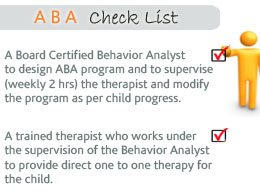
ABA programs are usually conducted within the child home or even in the class room setup under the supervision of a board certified behavior analyst. Learning and communication abilities of children with autism improve considerably by undergoing ABA therapy consistently (Minimum 40 hours/week).
ABA techniques include motivating children with positive reinforcement techniques and various associated strategies to acquire a new skill. ABA Therapy is a tailored to meet each kids individual needs and modify their behavior accordingly. ABA involves:
- Application of various behavioral techniques to assess the behavior
- Develop the basic functional skills
- Methods and techniques/tools to measure the progression
In ABA a complex task is broken down to smaller ones (task analysis) and the child will be given enough opportunities repetitively to achieve that task. Child will be positively reinforced as he acquiring new skills.
Early intervention and consistent ABA therapy will definitely help to improve in all functional areas of the child.
TEACCH for the treatment of autism
It's an evidence based training program for kids with autism. Autistic children of all age and skill levels are found to be benefited by TEACCH program. Expansion of TEACCH is Treatment and Education of Autistic and Communication related handicapped Children was actually developed decades ago in North Carolina university. TEACCH mainly uses visual cues and picture schedules. Some benefits of TEACCH programs are:
- Helps the children in the spectrum to work independently
- Make them more organized and work in structured environment
- Improves the adaption skills and communication skills
MEDICINE For Autism
Till now there is no single standard >medicine invented for autism treatment, which cures autism completely. Medicines can be used to improve the symptoms of autism. Some of them are:
- Attention Issues and Hyperactivity
- sleep disturbances
- Mood swings and tantrums
- Irritation and aggression
Currently Antipsychotic medicines, such as Risperdal and Haldol,only is approved for the autism treatment of kids under 15.They may help to bring down hyperactivity ad aggression of children with autism. Remember these medicines have its own side effects as well.
DIET for autism
Children with autism shown moderate improvement in their behavior and speech, after removing substances like gluten and casein from their regular food ( GFCF Diet), as per parents and researchers findings.Gluten is found in following foods:
- Barley
- Oats
- Wheat
- Semolina
- Malt,Soy sauce and vegetable proteins
- Yoghurt and cheese
- Milk , ice-cream and other milk products
If you are planning for any diet changes for your autistic kid as part of autism treatment, it should be made only after consulting a dietician which will make sure that child will be getting a balance diet.
For any autism treatment service Dubai/Sharjah or anywhere in United Arab Emirates (UAE), you can call us or write to us.